


Postural Therapy & My M.S. in Education
Raise you hands if you've had to learn something which initially had no connection to your needs or interests only find that you now use it all the time to benefit yourself and others?
In May of 2020, I completed an Advanced Master's Degree in Applied Exercise Physiology from Teachers College, Columbia University. Many of the classes and concepts I learned in the program increased my understanding of the body...and mind...which correlate to helping people to a greater degree as a Postural Therapist.
Fifteen years prior, I did a Master's in Early Adolescent Education. One of the required courses was ESL: English as a Second Language. I had zero interest in this topic and couldn't see where I'd be applying the concepts anywhere down the road.
Go figure that the main concept I took from the entire program frames much of I how I help people get out of pain, move more effortlessly, breathe better, and increase daily quality of life.

The concept: 'i+1'
i = What the student (English learner) already knows.
1 = One new piece of information for the student to learn and apply in that lesson
Essentially, it's layering and ingraining new information on top of the old and progressing step-by-step.
What does this have to do with Postural Therapy??
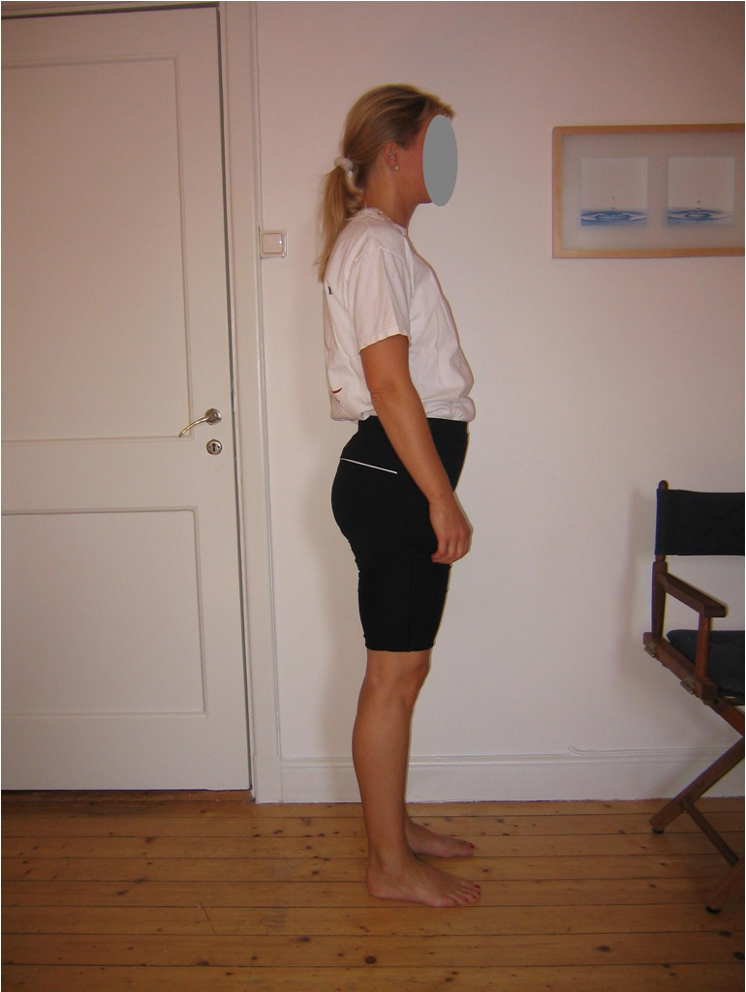
Look at the two pictures of the woman above and below. Notice how:
Front view: her right leg collapses in, right arm is more rotated than the left, and to protect her weaker right side, she shifts her body weight onto the left side.
Side view: her lower body shifts forward, upper body collapses back, and head comes forward.
Her compensations might create grinding in the right knee (misalignment), an overuse injury on left left hip (increased load), compression in her spinal discs (collapsing back), and neck tension (muscles overused to keep head up).
In addressing the full body mechanism to help her an approach I might take would be to sequentially:
Align her body from the side with a position such as the Static Back, as elaborated on in this previous article: https://conta.cc/3XplcBe
After five minutes of allowing her body to settle and balance in this position, I'd give her a few simple exercises to change the position of her arms and shoulder blades, getting her out of the internal arm rotation. Next, she might do knee pillow squeezes (squeezing and releasing on the block) to engage the deep postural line which will strengthen her from the inside-out and subconsciously maintain these adaptations. We could conclude with an exercise or two to allow full spinal movement (ie. Cats and Dogs; Cat/Cow). She'd receive this sequence to do on her own to ingrain her body's new alignment.
In sequence two, we might begin with an Air Bench (squat against the wall, flattening her lower back to mitigate the tension she surely has there from collapsing back on it). Next, we could return to Static Back. Now, that's she ingrained basic movements in this position, I could progress her to more challenging exercises that deeply ingrain postural strength. We'd conclude with a dynamic exercise or two standing to more strongly promote spinal extension and postural strength.
Once she ingrains these patterns we'd layer a few new ones on top of what she's already created (ie. starting to align her right leg).
Can you see how we're using 'i+1' in helping her long term? We're creating new patterns in her body. She's reinforcing and ingraining the patterns when doing the sequences on her own. The next sequence takes where she is now, keeps the framework or the previous one, and changes a few things (not everything) as progressions.

It's been fun using this way of helping people progress on both a highly individualized level and with the multi-week Postural Therapy programs. This flow is creating an even greater impact for the participants, which is rewarding for me to see and them to FEEL.



Comments