


The Posture of Stress
I want to revisit and share the insights below, showing how stress can manifest in your body and posture.
Picture yourself walking in your favorite place in nature on a beautiful day. You're relaxed, enjoying the sounds of birds chirping, seeing the fully bloomed trees, smelling the freshly cut grass. {Really put yourself there, it will help with understanding below}.
BOOM! All of a sudden you hear and explosion. You're STARTLED! You cringe; "jump out of your shoes".
Exhale, threat averted; it was only a car backfiring. At the same time, you noticed that your body reacted a certain way when this sudden huge stressor occurred. Let's briefly explore this STRESS RESPONSE, how it manifests posturally, its effects on your health, AND how humans constantly maintain levels of this response without recognizing it.

What happens in the STARTLE RESPONSE:
Within a few milliseconds the muscles of your jaw begins to contract, and then your eyes and brow squinch. The impulse from your nervous system raises your shoulders and brings your head forward. You bend your elbows and turn your palms down. Your abdominals begin to contract; sexy, right? Who doesn't want tight abs! Wrong! This contraction forces your trunk forward and pulls down on the rib cage, lessening breathing and causing GI problems. Going down your body, the knees bend and ankles roll the feet inward, lifting the toes. You tighten your crotch as this is entire response is a protective mechanism and you certainly want to protect here!
{Try each compensation with your body to better understand and recognize when these occur to you}

This response is shared by both humans and animals alike. It lies deep in the primitive parts of your brain and occurs much faster than your voluntary reactions. "Withdraw now and think about it later" (Somatics; Thomas Hanna). In animals, this is typically an all-or-none response. Picture and animal fully round its back and tuck it tail when startled. There is no middle ground here for an animal. Even a human baby, will cry and flail its arms when stressed, which takes the stress from inside the body and dissipates it away.

As adult humans, we are blessed with having greater brain functions than all other mammals. We are able to think and create interpretations, ideas, understandings based upon these thoughts. While this sets us apart from all other mammals it also typically eliminates the all-or-none basis ability to dissipate the stress of the Startle Response from the body. We're left with "residual tension" that gets somatically ingrained. We worry, have anxiety, get disappointed, etc; all of these are absorbed by the body in a very systematic way and become ingrained with a specific posture.
You may begin to notice:
Wrinkles begin to develop in your face/around your eyes - worrying causes the muscles here to contract
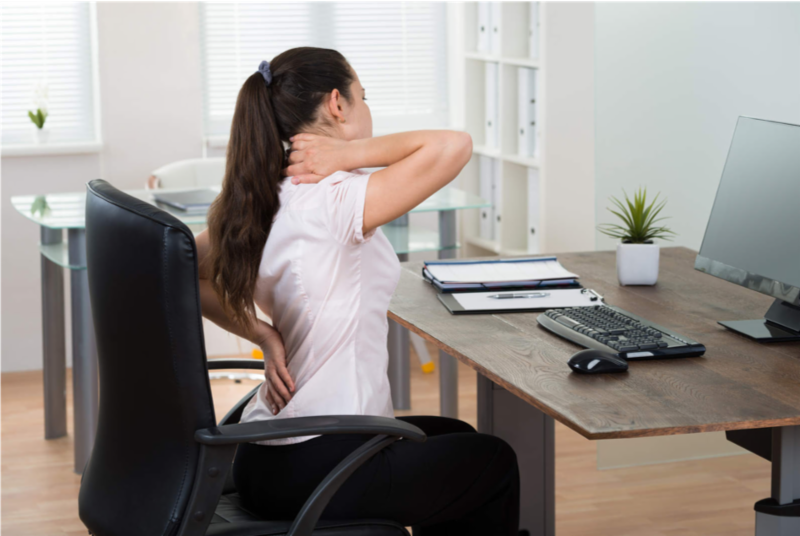
A hump develops in the back of your neck - anxiety can cause your neck to raise, bringing your head forward. The muscles in the back of your neck have to overwork to prevent your head from falling forward.
Shoulders round - think about the position to bring your hands when you say "oy vey"
Your chest may be a bit flatter than it used to be.
Your breathing becomes shallow - constricted rib cage here prevents full breathing; less oxygen to the brain can create further anxiety
Stomach issues - abdominal muscles contracted compress the internal organs
Frequent urination; constipation, hemorrhoids - same cause as above
Heavy legs - walking with bent knees causes the muscles in the front of the legs to overwork
What can you do about it?
The specific postural compensations of the Startle Response flex/curl your body forward, bringing the front points of your body closet to each other. Be mindful of what parts of your body tighten to which stressors. For example, each time I'd putting off writing this article and being frustrated by it, I'd feel the muscles in both my face and stomach contract and remain tight. Once you can feel where you're tight (and by which trigger) you can try to release that tension. You might consider a Standing Quad Stretch for tight quads (front of the leg). A more advanced stretch for tight shoulders, chest, and neck can be one as such taken from yoga. This really stretch the front of your body; counteraction the body lock from the stress response.

Our bodies are brilliant in their ability to adapt and repattern any unwanted response. My focus in helping my Postural Therapy clients who have these compensations is to release these tensions while at the same time engage deep, underlying postural muscles which will put the body back in it naturally designed position - and keep it there. Though this is very individualized (concepts addressed in previous articles), paying attention to where you feel the stress tension and releasing it through stretch should indeed make a considerable difference in how you feel and function in many ways.
I'll be interested to hear how this works for you.


Comments